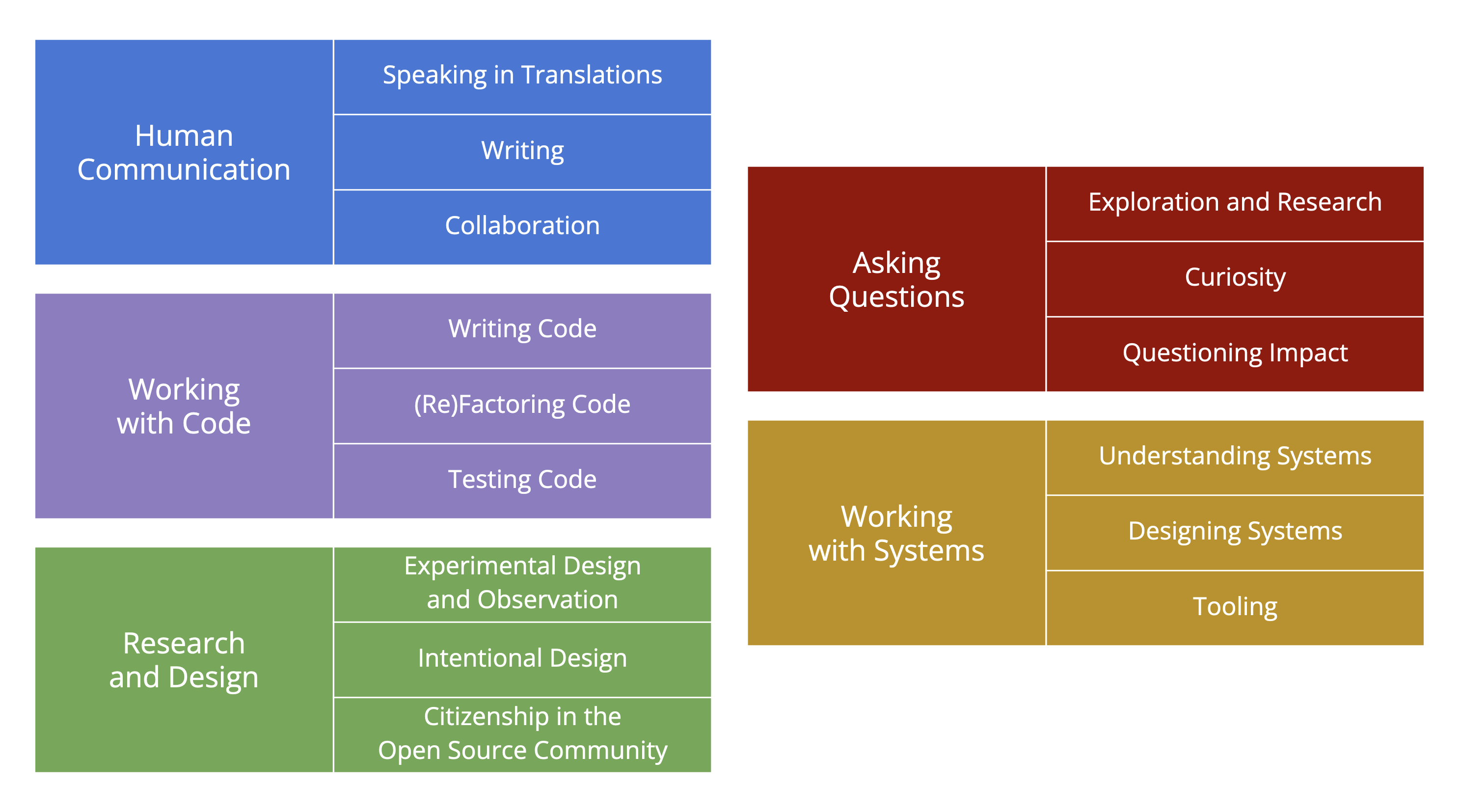
This framework encodes the model for AI use that I ask students to use in my classes. It argues that all work falls into one of six categories, and that discerning which category is at play is important for both the teacher (in determining the purpose of the assignment and what will be assessed) as well as for the student (in determining what they are supposed to get out of the assignment). The model was designed for AI and then broadened to apply to all forms of "Generative Assistance" (GA), which includes tutors, friends, forum posts, etc. It is also the framework that I hold myself to as an adult, human, and teacher.
In the fall of 2025 I began writing a model for responsible use of AI in direct response to student complaints I heard around campus — that teachers said "don't use AI" but were clearly (and hypocritically) using AI themselves. This hit home for me: I use AI at work (and at home) extensively, and although I was also allowing students to use AI in class, I was getting away with a vague statement: "you can use it in this class because the code AI generates is so bad it won't help you." That loose sort of statement is neither true nor useful at this point, if it ever was. Students can certainly generate high-quality code with AI, and also need guidelines for when it might be beneficial or honest to do so, and when it is not.
The more I considered the idea of students claiming that teachers were being hypocritical, the more I realized that my intent wasn't matching what I said in class. I'm very intentional about my AI use and try to structure it well. I also experimented relatively early (and continuously since then) with various uses of AI, rapidly determining which modes fit both my natural mode of operating and my ethics. In an attempt to be as transparent as I wanted to be, I found myself trying to encode my own personal AI delegation rules into a framework that would work equally well for students as it would for teachers.[1]
The framework described below is a descendant of that original formalization of my ethics, stress-tested through numerous students and colleagues, as well as numerous conference participants[2] and a few AI experts. It has, however, changed substantially since then. Originally it involved a claim that all work (in my class or in my own profession) fits into six categories. Although I still hold that this is true, there is now more room for discretion between the categories, as you can see in the text below.
I will also acknowledge that the question has shifted under me during the process. I originally thought the framework was helping people determine whether AI use was acceptable in a certain scenario, and if so, in what manner they should go about it. Now, it's a question bigger than that, because the same framework applies equally to tutoring, online forums and in-person consultations: "Am I outsourcing work that should still belong to me?"[2] More precisely, the framework is an early attempt to define a common language for cognitive work so that teachers and students can agree on what is actually offloaded and whether it should have been.
Numerous experts have told me that such a framework, shared between teachers and students, is an impossible thing to create. I fundamentally disagree — and more so, believe that we should only ask students to abide by guidelines for which we also follow the age- or role-adjusted analogues. To me, this is the definition of integrity in the classroom. Your definition of integrity might differ. This idea might feel uncomfortable, or it might help provide clarity. In either case, I encourage you to share feedback.
Most arguments I've heard about AI in schools aren't really about AI — they're about classification. Students and teachers often agree that learning matters, and they often agree about the high-level goals such as "AI shouldn't replace the purpose of the assignment." What they don't agree on is a shared language for describing what "replace the purpose of the assignment" means. Purpose for whom? In what role? With what assignment? And what level of challenge and/or accommodation?
Three examples show why these details matter:
The first produces an unacceptable outcome regardless of role or process. The third may produce excellent prose while still feeling fundamentally wrong because the value of the task lies in authentic expression.
In some ways, the second is the most interesting: it may be entirely appropriate for a teacher but problematic for a student, depending on the learning goal. As a teacher, it's very likely that I gave AI bullet points and made sure it was an authentic reflection of my knowledge. And drafting a simple note on material is a reasonable outsourcing, preserving my capacity so I have more energy to bring to my unique contribution (feedback to students, perhaps). But as a student, that ask is probably not an authentic expression of my knowledge and is almost certainly replacing the intended work of understanding and distilling knowledge. It might still be acceptable if doing so reduced labor on the project to a degree that I could access another core part of the project, but it seems much less likely.
The strongest reactions I've seen to AI ("Absolutely not!" and "did someone actually do that?!") have come from scenarios I posed to others, both teachers and students, where generative tools appeared to replace what people expected to be a uniquely human contribution: basic decency between humans, relationship-building, what it means to give a genuine compliment. Those reactions point toward something beyond cognitive work and towards ownership and authenticity.
These examples suggest that people are evaluating more than one thing at once. They are judging outcomes, processes, roles, and authenticity. The original framework focuses primarily on process, but the newest version focuses more on discretion.
Questions on the motivation for this transition? The above is a lightly edited excerpt from a workshop report[2] I wrote in June 2026.
Because the 5Cs ask you to classify your work based on categories like contribution and core purpose, you must first figure out what those high-level ideas are for you. This is part of the framing, or context, of the delegation problem. You should be able to answer:
We always inhabit multiple roles, but which is most relevant in the moment? A human, a student, a daughter, a friend…
This is a matter of some discretion. Most people have very firm notions of what the core purpose is of a teacher, student, human, or friend, but we often have a tough time specifically naming that core purpose. Luckily, if you are a student working in this model, you will likely have received some indications from your teacher as to what your core purpose is. Broadly speaking, a student's core purpose is to learn and grow, and a teacher's core purpose is to teach. (Specifically, I believe a teacher's core purpose is to help students to 1) know themselves and the world around them with increasing levels of accuracy, and 2) act with increasing levels of agency and good judgment on the world around them.)
What are the things I do in my day to day that support me in learning or in teaching? For the purpose of the text below, you can assume that:
This question addresses the ways in which it is important that you, specifically, are undertaking this activity. Is it because the activity acts meaningfully to change you, or because you act meaningfully to change the output to something else? Whatever that important individual interaction is, is your contribution.
The questions above only need to be answered once per class, and perhaps less often. But they are important to situate a person in their context so they know why they are pursuing and can navigate with an accurate compass.
Impact check Before deciding what mode your work falls into, and what it is outsourcing, first consider the impact or consequences of the work. All else being equal, are you creating something that has a positive (or at very worst, neutral) impact on the world? If so, proceed and find the appropriate work category. If not, better stop and double check your impulses.
Contribution, previously listed as creativity. An individual's unique contribution could be external - they bring their unique perspective and lived experience to bear on an artifact for others. Alternately, we might consider the unique contribution to be bringing oneself to be changed by the activity, as with many learning activities. The former is both more common and easier to consider, however.
Reflection When determining if this work is outsourcing your contribution, ask yourself: Am I still visible in the final output? Am I changed by the process? Did I bring my ideas, relationships, individuality, or authenticity to bear on this activity before seeking generative assistance?
Motivation Creativity begets creativity. When you engage in creative work, and offer your unique contribution to a body of work, it builds your intuition, taste, and problem-solving instincts. It builds your capacity for authenticity and vulnerability to critique and feedback. Unused cognitive muscles atrophy. To develop yours, generate your own idea or attempt first, even if it's incomplete. Afterward, GA can help expand or refine what you've already created.
Examples Work that falls into this category might include brainstorming, sketching ideas, modeling, exploring patterns, ideation, generating multiple approaches, trying something before you know it works. Writing almost always falls into this category.
Side note - there are some instances where you as a person don't want to own the creative authorship for your project. This is likely okay on personal projects, but don't assume it's acceptable in class.
Core activities, previously listed as core skills. These are the activities that support my core purpose in this role (see Framing). For a student, these activities are often the discipline-specific competencies or content learning. For a teacher, it is the activities that make it worthwhile to show up in the classroom each day.
Reflection To determine if you are outsourcing the core activities, consider whether the outsourced work could plausibly be seen as the reason you were handed the activity. If so, did you make a solid attempt before asking for generative assistance? Did you audit the results handed to you by GA? Did you ask for revisions, reject suggestions, or clarify your own understanding of the task after an initial response?
A good check if you've put in an honest attempt is whether you can fill in the following blanks:
"I am trying to do [skill or action]. I tried and expected [desired result] but instead got [actual result]. I then attempted these things: [list three revisions or additional actions, like research]. I saw the following results [list results from revisions]. Can you help me?"
Motivation For core activities, it is expected both that you are activating your own expertise and skills and that you are not working to exhaustion in pursuit of the core activities. These are the activities for which you likely bear the most responsibility. Therefore, whenever you engage GA in a core activity, you are responsible for auditing the response using your own understanding to check its validity. These skills cannot be fully outsourced without extreme liability.
Examples Work that falls into this category might include building, writing, reasoning, analyzing data, revising your own work, and working through or learning a procedure.
Clarifying issues is a specific sort of skill - it is locating the place where you have gone wrong. We can use generative assistance to help us see more clearly where the issue might be, but it shouldn't be used to do the actual identification or diagnosis, or choose a solution for you. Instead, it should be helping zoom in on the right area or space for problem solving.
Reflection In determining whether you are engaging in clarification, ask yourself: Do you have a problem to solve? If so, do you know what the problem and the fix are? If you don't know either, you're probably clarifying.
The same sentence starter from C2 applies here, but so does this one: "I was doing [action] and got an unexpected result I cannot understand: [error or crash], can you help me interpret the meaning of that output, without knowing what my code or solution looks like?"
Motivation When you know neither the specific problem nor the specific fix, you may often need help to figure out where to look next. Traditionally, we've done this by asking for help from a TA, instructor, or even just Google: "what does X mean?" The real test of this skill is whether you found the solution after engaging GA, or whether you got just enough information to engage your own understanding with GA's scoping.
Examples Work that falls into this category might include interpreting error messages, understanding unexpected output, clarifying confusing terminology, unpacking instructions, identifying what "could" be causing a problem, understanding a surprising result in code or math.
Side note: At some points in a course or project, clarifying issues might be a core skill. But for the most part, this is its own category.
Correcting issues is a core skill, always. When you arrive here, you can always Clarify (C3) but you must use your Core Activities (C2) to actually make a revision.
Examples Work that falls into this category might include determining the cause of an error, performing tests, choosing a debugging strategy, updating your code or reasoning, verifying which hypothesis is correct, or repairing a flawed argument.
Side note: the C3-C4 boundary can be a fuzzy one, and some generative helpers (like AI and eager friends) like to help. Sometimes this means they volunteer to take over and do the diagnosis or the fix for you. If this happens, acknowledge it and revise your asks for next time - be proactive about fending off GA's corrections. If it continues happening, then your core skills are not growing! Seek help!
Cost, previously listed as construct plans. Overwhelmed? Not sure how to step forward or what the first step is? Sometimes the thing that makes work hard is the core activity itself - it's the actual effort of learning, growing, teaching, or just being human. We don't want to avoid life and outsource everything, but sometimes outsourcing things that aren't part of the core activities allows us to handle the core activities with more capacity.
Reflection Ask yourself: Is this reducing load outside my core purpose and/or increasing capacity to handle something inside the core purpose?
Motivation GA is welcome to support your executive functioning and study skills - this is a great use of technology. Just be sure you still get the practice in breaking down tasks by yourself some of the time, or you will find yourself overwhelmed by more and more simple tasks. Remember, unused muscles atrophy! Technology can sometimes also help offset the cost in time, money, or unnecessary cognitive load (such as understanding assignment instructions written in your second language).
Examples This includes planning projects, organizing multi-step work, generating checklists, mapping out your week, breaking down large assignments, prioritizing tasks, etc.
If your task doesn't clearly fit any of the 5Cs above, it is likely reflection.
Reflection If you are taking a moment to create insights about your own patterns and learning, you are reflecting. Ask: Am I thinking about what I learned, did wrong, did right, or had skill gaps in? Can I state my learning before engaging another opinion to sharpen, clarify, or restate that learning? Is that reflective insight mine?
Motivation The core activity of all people who are growing is metacognition: thinking about your thinking. Reflection is one of the best ways to engage metacognition, and it is impossible to outsource while retaining the benefits, without a great deal of practice. While you can sometimes do "social thinking" about your own thinking, often times doing so injects someone else's thoughts and opinions about your thinking into the mix. For this reason, reflection should always be a solo (non-GA) activity.
Examples This includes personal insights, "what I learned," documenting your process, evaluating your growth, or any writing that requires your own perspective.
Remember, GA cannot know what lives inside your head unless you say it in your own words. That "putting experience into words" is what builds your mental models. And... once it's out there, use it! Do not let GA abstract out all personality and experience from your words.
Using AI, in my view, is almost always allowed, and sometimes even encouraged. However, in every case we should be using AI with integrity and that includes the following Three O's
Use AI intentionally. Know when you're asking AI to do something and what you're asking for. Specifically, what verb do you want AI to be doing for you?
An example - I asked ChatGPT to help me organize some bulletpoints when I was building this framework, without changing any words: that's organizing. I also asked Claude code to "... build me out a static page for the AI framework that has a design similar in feel to the other pages ... and has placeholders for ... Please hook it up in all of the sane places and then I will fill in the text." That's Claude building and designing for me. [4]
Be transparent about when and how you use AI. That means naming the work done by AI, even if you feel like it didn't show up in the final project.
Continuing the example: I used ChatGPT to process my thoughts in August of 2025 when I was distilling these ideas. However, the AI did not come up with any categories and the text on this page is all mine. The webpage itself was primarily built with Claude Code (and a lot of back and forth).
It should always be clear who owns what part of the work you are presenting, and what you are claiming as yours.
Again, an example. The ideas on this page are mine, full and clear. The design of the webpage is shared ownership between AI (ClaudeCode) and myself. I'm comfortable with this, because I am not building my webdesign skills right now.